Sharp Exchange Between Iran and the United States at the Security Council Amid War
March 1, 202688 ViewsRead Time: 2 minutes
Font Size:
16
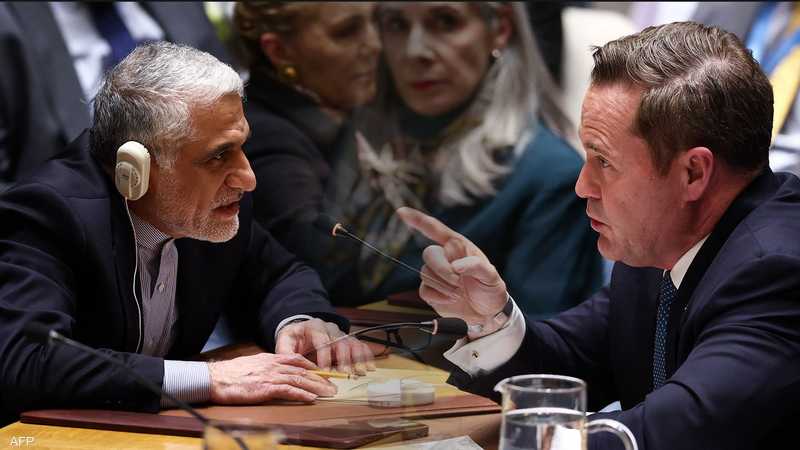
An emergency meeting of the United Nations Security Council witnessed a sharp exchange between the Iranian representative and the U.S. representative, in light of the U.S.-Israeli military attack on Iranian territory and the escalating regional tensions.
Direct Debate Between the Representatives
At the end of the session, Iranian Ambassador Amir Saeed Iravani addressed his U.S. counterpart, saying:
"I have only one word, I advise the U.S. representative to be polite; it would be better for yourself and for the country you represent."
U.S. representative Mike Waltz responded by saying he would not engage in a similar debate, adding that the Iranian representative "sits here representing a regime that has killed tens of thousands of its own people and imprisoned many just for demanding freedom."
U.S.-Israeli Defense of the Attack
During the session, the United States and Israel defended the military strikes targeting Iran, considering that preventing Tehran from acquiring nuclear weapons is a "necessity for global security."
Waltz stated that the international community has repeatedly affirmed a fundamental principle of not allowing Iran to possess nuclear weapons, noting that U.S. actions fall within what he described as the legal framework for protecting international security.
Tehran Accuses of Committing a "War Crime"
In contrast, Iran accused Washington and Tel Aviv of committing a "war crime," pointing to civilian casualties during the strikes, including dozens of children according to the Iranian narrative.
The Iranian representative also considered that some council members practice "double standards" by ignoring the U.S.-Israeli attack and condemning the Iranian response.
UN Warning of Regional Explosion
For his part, UN Secretary-General Antonio Guterres warned of the dangers of military escalation, considering that current military operations could lead to a series of uncontrollable events in one of the most tense regions of the world.
Guterres stated that mutual escalation poses significant risks to regional stability, calling for restraint and avoiding the region sliding into a wider confrontation.
