The Clash Reveals Something Deeper Than Just Statements... Is Trump Leading America to a Major War Under Netanyahu's Umbrella?
April 19, 20261886 ViewsRead Time: 2 Minutes
Font Size
16
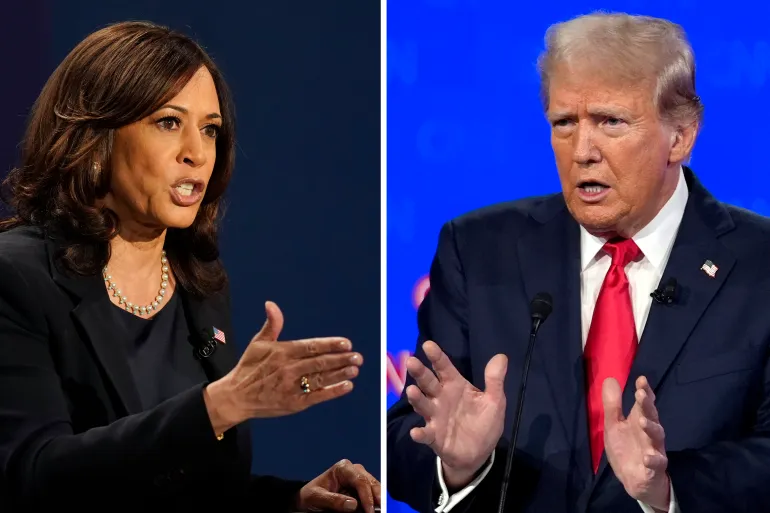
The clash between Donald Trump and Kamala Harris reveals a division that goes beyond electoral competition, reflecting a deeper malfunction within the structure of American decision-making, where political calculations intertwine with national security considerations at a highly sensitive international moment.
This division is not only evident in rhetoric but extends to how the role of the United States is defined globally, especially regarding its relationship with Israel. While Trump adopts unconditional support driven by political and electoral calculations, Harris attempts to recalibrate this support within a more cautious approach, balancing commitment to allies while avoiding slipping into a broader conflict.
However, understanding this divergence is incomplete without considering the nature of decision-making in Washington, which is not limited to the White House but is distributed among overlapping institutions including the Pentagon, Congress, and lobbying networks. This entanglement makes foreign policy less subject to individual decisions and more susceptible to complex internal balances.
In this context, wars do not always seem to be the result of a direct decision, but rather the outcome of a gradual escalation process, where positions and miscalculations accumulate. The recollection of the Iraq experience reminds us how limited justifications can lead to prolonged and costly military engagement.
The picture becomes more complicated with the economic factor, which not only acts as a constraint on decision-making but can also become an indirect driver, given the connection between defense industries and centers of influence, creating an intersection between economic and political interests.
Additionally, elections add another layer of pressure, as Trump employs a rhetoric of strength to enhance his image as a decisive leader, while Harris bets on risk reduction, transforming foreign policy into a tool in the internal struggle and increasing the likelihood of decisions being made under electoral pressure.
As a result, American diplomacy today appears fragile, as ongoing efforts focus more on containing escalation than providing radical solutions, leaving the door open to multiple scenarios, from temporary calm to broader escalation.
Ultimately, the scene is not just about Israel or Iran, but about the future of the American role itself, as Washington stands at a crossroads: between rearranging its priorities towards domestic issues or continuing its external intervention approach.
In light of this complexity, trends will not only be determined by ballot boxes but also by the ability of American institutions to manage this division without slipping into costly decisions.