The Pitch Drop Experiment Reaches 100 Years: The Longest Scientific Experiment in History
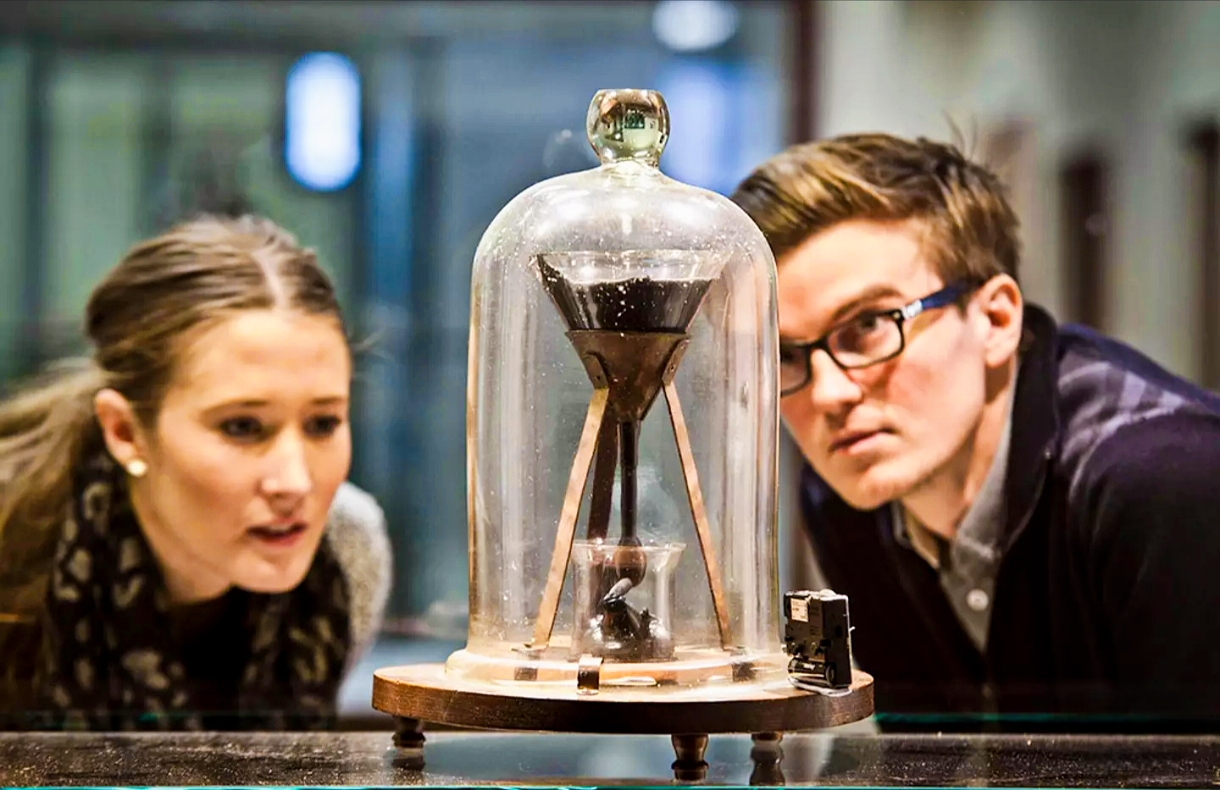
The world celebrates this month the centenary of one of the slowest and longest scientific experiments in history:
The Pitch Drop Experiment, which began in 1930 and is still ongoing today, embodies patience and scientific precision at its finest.
The story began when physicist Thomas Parnell from the University of Queensland filled a funnel with black pitch, one of the most viscous liquids on Earth, in 1927.
After three years, he cut the funnel's stem, announcing the start of the experiment, which aims to observe the pitch dripping very slowly.
Pitch may feel solid to the touch, but it is actually a liquid that is a hundred billion times more viscous than water.
The first drop did not drip until eight years after the experiment began, and since then, drops continue to fall at a rate of about one drop every eight years, with only a temporary halt after air conditioning was installed in the building during the 1980s.
To this day, after 96 years, only 9 drops have fallen, the last one in 2014, and scientists are still awaiting the fall of the tenth drop within this decade.
Despite the experiment being monitored via live broadcast, no one has witnessed a single drop live due to previous technical failures.
Historically, after Parnell's death, physicist John Mainstone oversaw the experiment from 1961 until 2013, but he did not witness any drop himself, missing many critical moments, including the drop he missed due to a thunderstorm in 2000, and the next drop in April 2014 just months before his death.
Today, the experiment is supervised by Andrew White, the current professor of physics, who eagerly awaits the tenth drop, continuing one of the slowest and most impressive scientific experiments in the world, which proves that patience can sometimes be a scientific tool in itself.

