How Will the Earth End? The Final Scenario According to Science
Talking about the end of the Earth may seem like a scene from a science fiction movie, but scientists confirm that reality is more terrifying... and more beautiful at the same time.
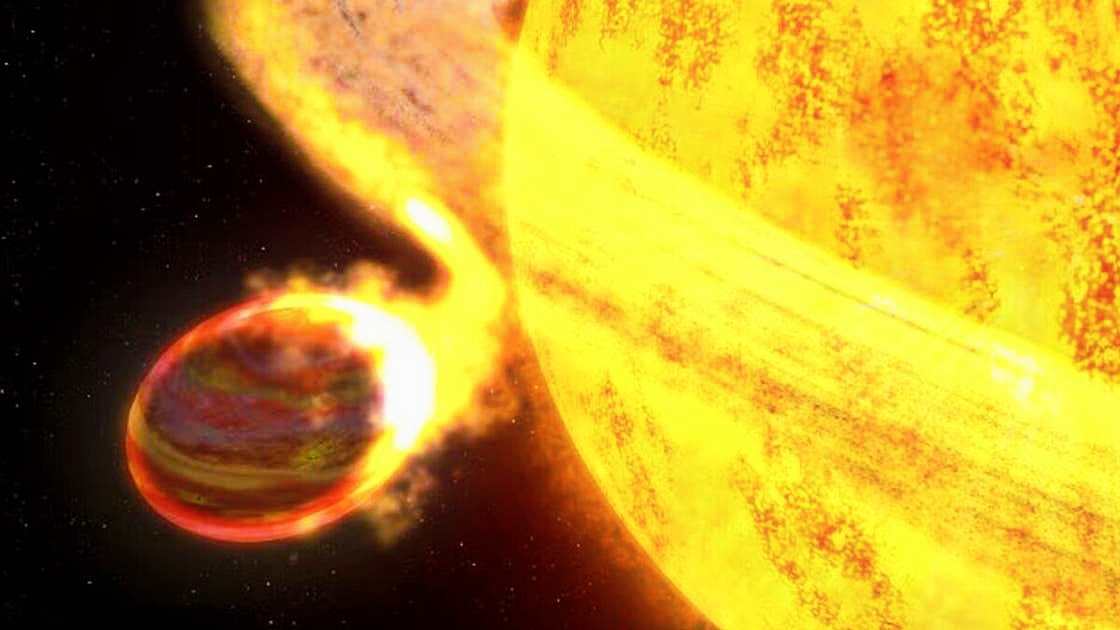
According to the latest scientific images and visions published by NASA, the planet Earth will not suddenly disappear, nor will it explode or fade away in an instant, but will face a slow and long end, as it begins to melt inside a sun transforming into a red giant star in about five billion years.
* A Dying Sun... and the End of the Solar System
Scientists explain that the sun will gradually consume its nuclear fuel of hydrogen, which has maintained its internal balance for billions of years.
As this fuel depletes, the balance between gravitational force and the energy produced by nuclear fusion will be disrupted, causing the sun to undergo massive expansion.
During this phase, the sun will transform into a red giant that may exceed its current size by more than 100 to 200 times, in a terrifying scenario that could lead to the destruction of the Earth, either by swallowing it within the expanding sun or tearing it apart under the influence of immense gravitational forces.
* The Helix Nebula... A Window into Our Future
These predictions are based on stunning observations captured by the James Webb Space Telescope, which has provided the most accurate images to date of the Helix Nebula, located about 650 light-years from Earth.
The Helix Nebula is merely the remnants of a star similar to our sun, which exhausted its fuel thousands of years ago, leaving behind a vast shell of gas and dust extending nearly three light-years.
These images give scientists a close and disturbing glimpse into the potential fate of our solar system.
* From Red Giant to White Dwarf
During the advanced stages of the sun's life, the increase in heat at its core leads to the fusion of helium into carbon, a process that releases immense energy pushing the outer layers to expand even further.
In the final stage, the core of the sun collapses to become a dense white dwarf about the size of Earth, while its outer layers separate and spread into space, forming a planetary nebula similar to the Helix Nebula.
James Webb's images show that the radiation emitted by the white dwarf continues to sculpt complex structures within the nebula, with a clear contrast between regions of hot and cold gas, where complex molecules and dust grains are formed.
* An End That Is Not Pure Destruction
Despite the grim picture of Earth's fate, astronomers affirm that what happens is not mere annihilation, but is part of a grand cosmic cycle.
The materials rich in chemical elements, which are ejected into space after the death of stars, nourish the interstellar medium, later becoming the raw material that forms new generations of stars and planets, and perhaps other worlds capable of harboring carbon-based life.
Thus, the end of the Earth may just be a seed for the birth of new worlds somewhere in the universe... a destructive end, yes, but at the same time a new cosmic beginning.

