Will Air Control Overthrow the Iranian Regime? Strikes Revive Debate on Air Power's Role in Wars
March 9, 20261302 ViewsRead Time: 4 Minutes
Font Size
16
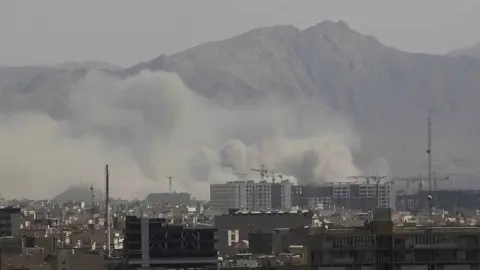
The air campaign launched by the United States and Israel against Iran has revived an old strategic debate within military circles: Can air power alone overthrow a political regime, or does regime change ultimately require ground forces?
The Wall Street Journal reported that this question has resurfaced strongly with the increase in airstrikes on Iran, especially following statements from U.S. President Donald Trump hinting that this war could lead to the overthrow of the Iranian regime.
Political Bet on Airstrikes
According to the report, Trump has expressed hope since the beginning of military operations that airstrikes would weaken Iranian leadership to the point of collapse.
He also urged Iranians to rise up against their government, considering the current moment a "historic opportunity" for change.
In later statements, he also indicated that the United States might play a role in selecting new leadership for Iran after the war, emphasizing that Washington would seek "unconditional surrender" from Tehran.
More Realistic Military Objectives
In contrast, U.S. military leaders have been keen to temper the political expectations of the war, asserting that the current operations remain primarily military in nature.
According to military officials, the strikes focus on destroying Iranian ballistic missiles, offensive drones, and military ships that threaten U.S. forces and their allies in the region, in addition to completing the destruction of what remains of Iran's nuclear program.
Admiral Brad Cooper, commander of U.S. Central Command, stated that the strikes could indirectly benefit the Iranian opposition by targeting the security institutions used by the regime to suppress protests.
Differences in Washington and Tel Aviv's Objectives
The report also noted a divergence in war priorities between the United States and Israel.
While Washington focuses on reducing Iranian military capabilities, Israel appears more inclined to weaken the regime itself.
U.S. Department of Defense officials clarified that the Pentagon's objectives are "specific and limited," primarily aimed at undermining Iranian offensive capabilities rather than necessarily changing the regime.
The Structure of the Iranian Regime Remains Intact
Despite the intensive strikes, analysts believe that the core institutions of the Iranian regime remain intact for now.
The Revolutionary Guard is one of the most important pillars of the regime, comprising about 190,000 soldiers, in addition to over 300,000 soldiers in the regular army.
The regime can also mobilize about 600,000 members of the Basij militia, giving it significant capacity to maintain internal control.
Indicators of Regime Collapse
Experts believe that the collapse of political regimes does not usually occur solely due to air bombardment, but rather as a result of internal factors such as splits within security apparatuses or the outbreak of widespread protests.
Among the indicators that may signal the regime's weakness are a rebellion within the army or the Revolutionary Guard, or widespread strikes in vital sectors such as oil.
However, these indicators have not yet appeared in Iran, according to what the report conveyed from American diplomats and analysts.
Lessons from War History
The debate over air power dates back to an old theory proposed by Italian General Giulio Douhet in 1921, which considered that strategic bombing could decisively win wars by destroying the vital infrastructure of the state.
However, historical experiences have shown the limits of this theory. During World War II, air bombardment played an important role but was not sufficient alone to defeat Germany or Japan without extensive ground intervention.
A similar pattern recurred in more recent wars such as the Gulf War in 1991, the Kosovo War in 1999, and the war in Libya in 2011, where airstrikes supported ground or local forces' operations.
Limits of Resolution from the Sky
Military experts believe that air power remains an effective tool for weakening the military capabilities of states, but it rarely provides a political alternative capable of ruling the country after the regime's fall.
Former U.S. Department of Defense officials state that overthrowing governments ultimately requires internal political forces capable of taking power.
According to military strategy experts, aircraft can destroy military capabilities and exert pressure on regimes, but changing governance remains a political process that occurs from within the state itself.
