The Struggle for Influence in Latin America: Washington Faces China's Expansion in Peru's Ports
February 22, 202661 ViewsRead Time: 3 minutes
Font Size:
16
The US-China competition is intensifying in Latin America, with Peru becoming an open economic and strategic battleground between Washington and Beijing, in the context of President Donald Trump's administration's efforts to re-establish US influence in the "backyard."
"The Monroe Doctrine" in a New Garb
The US actions are based on a security approach that considers the Chinese and Russian presence on the continent a direct threat to US interests, reviving the principles of James Monroe that reject foreign interventions in the Americas.
In this context, Peru emerges as a pivotal link in China's expansionist project under the "Belt and Road Initiative," due to its maritime location and mining resources.
Peru: A Strategic Trade Partner for Beijing
China accounts for about 40% of Peru's exports, while the trade volume between the two countries reached $51 billion in 2025, according to official figures.
Peru is the second-largest copper producer globally, a key metal in clean energy and electric vehicle industries. MMG Limited, a state-owned Chinese company, stands out as one of the major players in the mining sector, especially after receiving approval to expand the "Las Bambas" mine.
However, this presence is not without internal tension, as elected President José María Balcázar faces protests from local communities accusing Chinese companies of not distributing profits fairly.
"Chancay": The Chinese Crown Jewel
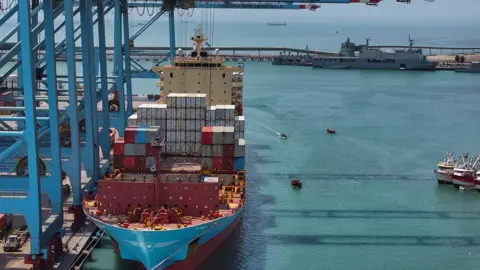
The "Chancay" port, managed by COSCO Shipping Ports with an investment estimated at $1.3 billion, is the cornerstone of China's maritime strategy in Latin America.
Specialized reports indicate that the port has reduced shipping time between the coasts of South America and Asia from 35 to 25 days, lowering transportation costs by about 20%, a development that gives Beijing a clear competitive advantage.
Counter Moves by the US
In contrast, Washington has intensified its diplomatic pressures, with the US State Department describing the project as a threat to the economic sovereignty of the countries in the region.
It has also signed a deal with Lima to develop facilities at the "Callao" naval base, a move interpreted as an effort to encircle Chinese influence along the Peruvian coast.
Political circles are discussing proposals to impose tariffs of up to 60% on goods passing through the Chancay port, while the US administration has already imposed a 10% tariff on products containing minerals extracted from mines operated by Chinese companies.
The Battle of Ports and Resources
The scene in Peru reflects a struggle that transcends economics to redraw the maps of global influence, where ports and mines intersect with national security considerations and geopolitical balances.
While Beijing seeks to establish a permanent foothold in the western part of the continent, Washington is moving to contain the "dragon" and prevent Peru from becoming a strategic platform for China on the other side of the Pacific.


