The Mystery of Tutankhamun's Death Returns to the Forefront After a New Astronomical Study
April 26, 2026848 ViewsRead Time: 2 Minutes
Font Size
16
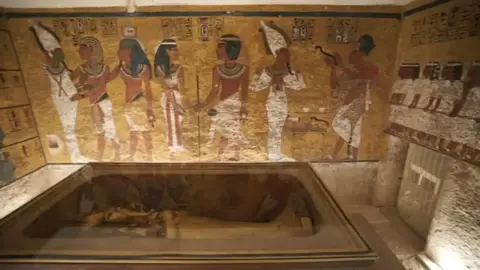
A recent Egyptian study indicates that the design of Tutankhamun's tomb was not random, but built according to calculated astronomical guidance.
This guidance reflects a close connection between funerary architecture and religious belief in ancient Egypt.
The "Union of the Revolutionaries" Phenomenon Explains the Timing of Tutankhamun's Reign End
Researcher Ahmed Awad explained that the tomb is linked to an astronomical phenomenon known as the "Union of the Revolutionaries," where the moonrise coincides with sunset.
This alignment occurred around the time of the king's death in 1322 BC, reinforcing the hypothesis of prior planning.
Were Astronomical Phenomena Used to Legitimize the Transfer of Power to Ay?
The study suggests that this astronomical alignment was not a coincidence, but was used to provide religious legitimacy to the transfer of power to Ay.
This employment is believed to reflect the intertwining of religion and politics during a sensitive period in ancient Egyptian history.
Karnak and Edfu Temples Support the Hypothesis of the Connection Between Astronomy and Power
The study strengthens its findings by comparing the axes of major temples like Karnak and Edfu,
where recurring patterns link celestial phenomena to the organization of religious and political space.
Did the King's Health Play a Role in the End of His Short Reign?
Although the study does not deny the role of illness in Tutankhamun's death, it opens the door to a parallel hypothesis.
The astronomical event may have been exploited to present the end of the reign as part of a sacred cosmic order.