Chickpea Cultivation Experiment on the Moon Achieves 75% Success
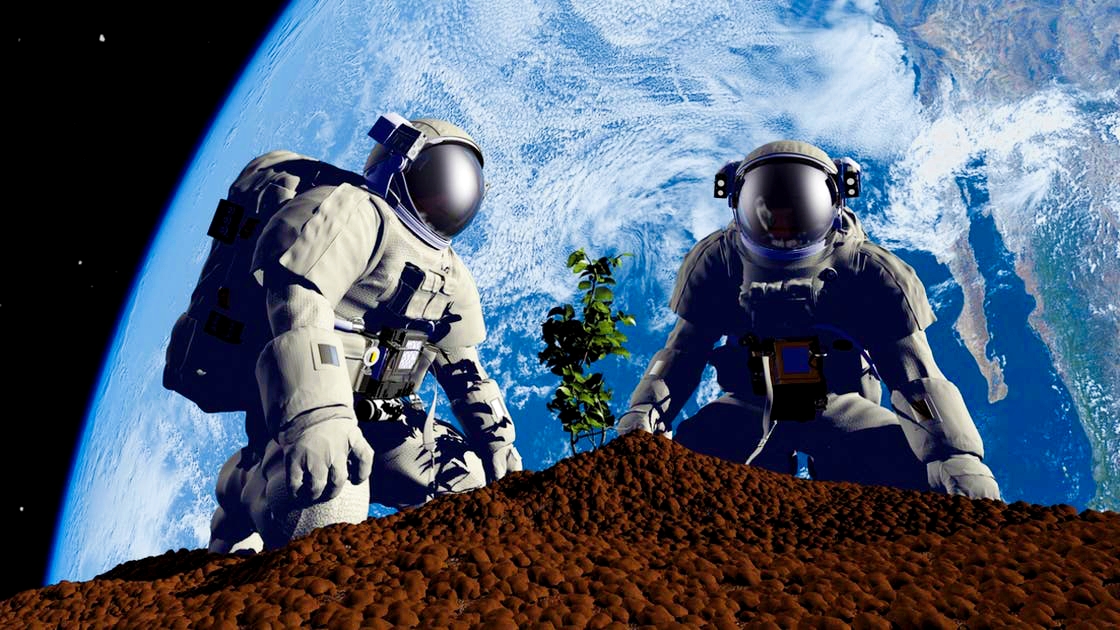
In light of the rapid scientific and technological advancements, scientists are getting closer to realizing ideas that once seemed more like science fiction;
a recent study from the University of Texas at Austin revealed the success of a chickpea cultivation experiment in simulated lunar soil, a step that could pave the way for providing food for astronauts in the future.
This experiment comes at a time when NASA is preparing to launch the Artemis 2 mission as part of its plan to explore the Moon and return humans to it, raising practical questions about how to provide food for astronauts during long missions.
Scientific Experiment for Chickpea Cultivation on the Moon
The new research showed that chickpeas could be one of the potential food options for astronauts in the future. In a recent experiment, scientists successfully grew and harvested chickpeas using simulated lunar soil, a material designed to mimic the geological composition of lunar soil.
This is the first time this crop has been produced in an environment simulating lunar soil.
The research was conducted in collaboration with Texas A&M University, and its results were published in the journal Scientific Reports.
What is Lunar Regolith?
The principal researcher of the project, Sara Santos, stated that the study's results represent an important step in understanding how to grow crops on the Moon's surface.
She explained that the research aims to understand how to convert a material known as lunar regolith into arable soil, in addition to understanding the natural mechanisms that could assist in this transformation.
Lunar regolith is the dusty material that covers the Moon's surface, but it differs from terrestrial soil as it lacks microorganisms or organic materials necessary for plant growth, despite containing some beneficial minerals and nutrients.
However, it may also include heavy metals that could hinder plant growth.
Improving Lunar Soil with Worm Castings
To test the possibility of growing plants in this challenging environment, researchers used simulated lunar soil produced by Exolith Lab, which is designed to resemble the samples brought back by Apollo missions from the Moon.
To enhance the soil's properties, the team mixed it with worm castings, a nutrient-rich fertilizer produced by red earthworms after digesting organic waste.
In the context of future space missions, worms could produce this fertilizer from waste materials such as food scraps, cotton clothing, or hygiene products.
The Role of Fungi in Supporting Plant Growth
The researchers also coated chickpea seeds with arbuscular mycorrhizal fungi, which live in a symbiotic relationship with plants.
These fungi help plants absorb nutrients from the soil and reduce the uptake of heavy metals that may be harmful.
After that, the team planted the chickpea seeds in various mixtures of simulated lunar soil and worm castings to study the effects of these conditions on plant growth.
Results of the Experiment
The study results showed that chickpea plants successfully grew in mixtures containing up to 75% of simulated lunar soil.
However, when this percentage was increased, the plants experienced severe stress, leading to faster mortality.
It was also observed that the plants treated with mycorrhizal fungi survived longer compared to those that were not treated, highlighting the importance of these fungi in supporting plant growth in harsh environments.
The study also revealed that these fungi managed to establish themselves within the simulated lunar soil, indicating that they may only need to be added once in a future lunar agricultural system.
Can Chickpeas Grown on the Moon Be Eaten?
Although the successful harvest of chickpeas from simulated lunar soil is a significant scientific achievement, several questions remain.
Scientists still need to determine whether the plants grown in this soil absorb harmful minerals and whether the resulting chickpeas can provide the necessary nutrients for astronauts.
In this context, Jessica Atkin, the lead author of the study and a PhD student in the Department of Soil and Crop Sciences at the University of Texas, said:
"We want to understand how viable these plants are as a food source, their health benefits, and whether they contain the nutrients that astronauts need. And if they are not safe to eat currently, how many generations of plants will we need to reach that point?".
The chickpea cultivation experiment on the Moon represents an important step towards the future food supply for astronauts and highlights the challenges of ensuring the safety and edibility of crops for human consumption.