Bezhkian Retracts Under Pressure from the Revolutionary Guard and Escalates Against Washington
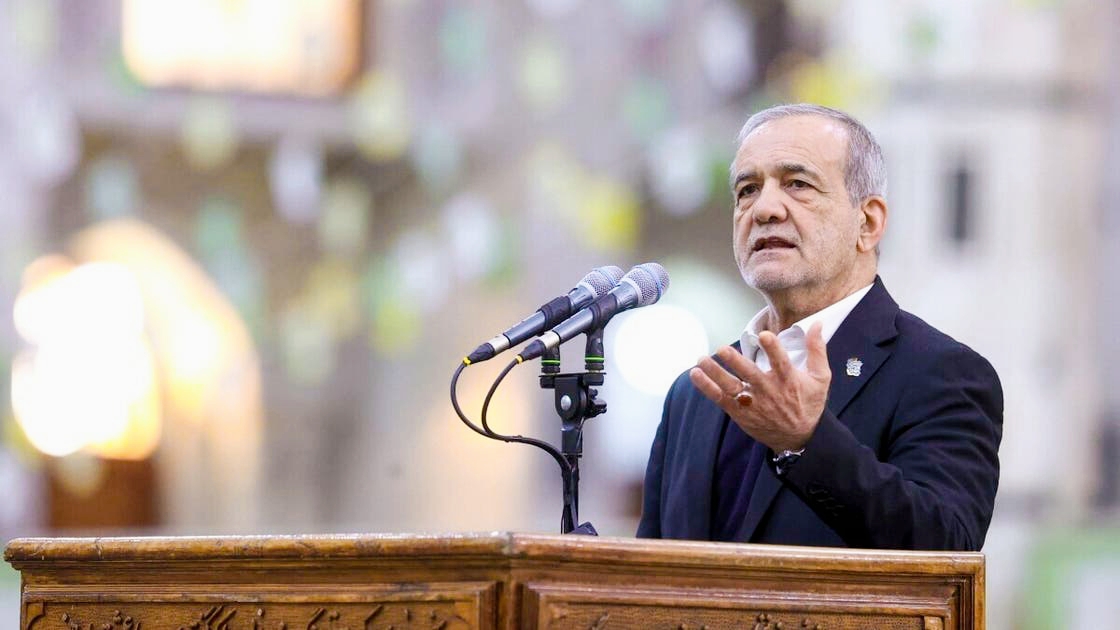
Iranian President Masoud Bezhkian partially retracted his apology to Gulf countries regarding the attacks on their territories, after his statement sparked a severe wave of anger within the corridors of power in Tehran, particularly among the Iranian Revolutionary Guard and the hardline conservative faction.
Bezhkian confirmed in statements made today, Sunday, that Iran will not back down in the face of military pressures, emphasizing that his country "will respond forcefully to American and Israeli attacks and will not surrender."
He added that relations with neighboring countries are based on brotherhood, but warned at the same time that any attack originating from those countries will be met with a direct response from Tehran.
The Iranian president clarified that what was interpreted as an apology or retraction was not so, considering that the United States deliberately distorted his statements.
He stated that "America turned my apology into surrender in an attempt to incite discord between Iran and its neighbors."
Bezhkian pointed out that "the Iranian people and its armed forces are present throughout the country and ready to defend it," affirming that Iran will not succumb to any form of "aggression or bullying."
* Sharp Criticism from Conservatives
Bezhkian's previous statements provoked harsh criticism from prominent figures in the conservative faction, as hardline cleric and MP Hamid Rasai attacked him via social media, considering the president's stance "weak, unprofessional, and unacceptable."
The head of the Iranian judiciary, Gholam Hossein Mohseni Ejei, stressed that Tehran will continue to target what he described as "points of aggression" in neighboring countries, accusing some of those countries of placing their capabilities in service of the "enemy."
According to media reports, Bezhkian's statements angered a large number of Revolutionary Guard leaders, prompting him later to delete the apology phrase when he reposted his statements on social media, in a move considered a clear retreat under pressure from hardliners.
* Internal Concerns and Accelerating the Selection of the Leader
These developments come amid rising concerns within the Iranian leadership, as several senior clerics have called for expediting the work of the religious body responsible for selecting the new Supreme Leader following the assassination of Ali Khamenei.
In this context, religious authority Ayatollah Nouri Hamadani called for speeding up the process, emphasizing that it is necessary "to thwart the enemy and maintain the unity of the nation."
* Revolutionary Guard: Capable of a Long War
For its part, the Iranian Revolutionary Guard announced that its forces are capable of continuing a "fierce war for at least six months" against the United States and Israel, indicating that it has targeted more than 200 American and Israeli sites in the region since the outbreak of hostilities.
In contrast, U.S. President Donald Trump confirmed that American forces have achieved "rapid and unprecedented victories" inside Iran.
In an interview with CBS, he stated that the U.S. military "destroyed Iranian missiles and drones and nearly sank the Iranian navy entirely."
Trump also pledged to continue military strikes against sites inside Iran, affirming that operations will continue until their objectives are achieved.
* War Enters Its Second Week
These developments come at a time when the war that broke out on February 28 between Iran on one side and the United States and Israel on the other has entered its second week, amid American and Israeli estimates that military operations will continue for several additional weeks.

